Chemical Protective Coverall for Industrial Cleaning: How to Select the Right Protection Level
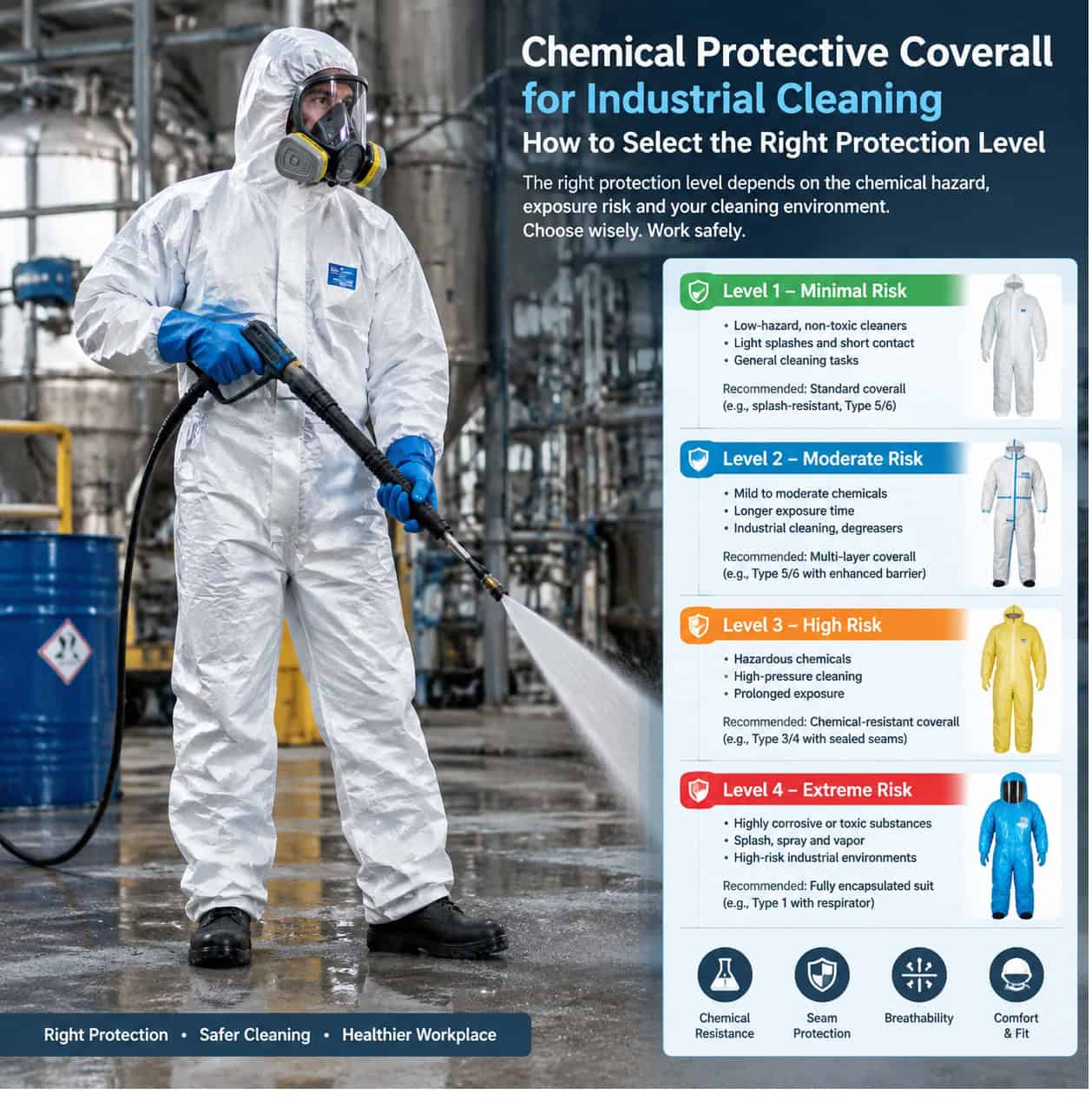 Most industrial cleaning chemical burns don’t happen because workers skipped coveralls. They happen because someone grabbed the wrong one. A blue suit from the supply closet is not a protection level. It’s a guess. And chemical cleaning is no place for guesses.
START WITH THE CHEMICAL, NOT THE COVERALL
The coverall is the last line of defense, not the first. Before you look at fabric swatches or price breaks, open the safety data sheet. What chemicals are you actually using? Sodium hydroxide in a floor stripper behaves nothing like acetone in a degreaser. A sanitizer that splashes gently from a spray bottle is not the same threat as a caustic solution pumped through a pressure washer.
Look for permeation data, breakthrough time, and degradation ratings. Permeation is the chemical sneaking through the fabric at a molecular level. Breakthrough time tells you how long you have before that happens. Degradation is the fabric losing its strength, stretching, cracking, or dissolving. If the SDS or technical data doesn’t give you those numbers, call the chemical manufacturer. If they can’t tell you, assume the worst and protect accordingly.
MATCH THE COVERALL TYPE TO THE TASK
Not every chemical protective coverall is built for the same exposure. In Europe, the common types are a useful shorthand. Type 6 is for limited liquid splash. Type 5 is for airborne solid particles. Type 4 is spray-tight. Type 3 is liquid-tight. That sounds technical, but the practical difference is huge.
If your crew is wiping down equipment with a mild cleaner, a Type 6 coverall might be enough. If they’re pressure washing a tank with a caustic solution, you’re in Type 3 or Type 4 territory. If they’re cleaning a confined space where liquid can pool, splash, and spray from every angle, a basic splash suit is a false sense of security. The wrong type doesn’t just underperform. It fails exactly when someone needs it most.
SEAMS, ZIPPERS, AND THE WEAK POINTS
A coverall is only as strong as its seams. Stitched seams leave tiny holes. Taped seams, welded seams, and heat-sealed seams close those gaps. For industrial cleaning, where liquid often runs down sleeves and legs, the seams are where the chemical gets in. Check the zipper, too. A bare zipper is a channel. A zipper with a storm flap, and ideally a double flap, is a barrier.
Gloves and boots matter just as much. Gloves should overlap the sleeves or be taped, depending on the suit and the chemical. Coverall legs usually go over the boots to shed liquid. Hoods should fit over the respirator without breaking the seal. Every interface is a potential leak. If you ignore the wrists, ankles, and neck, you’ve built a nice suit with four open doors.
MATERIALS: THERE IS NO UNIVERSAL SUIT
SMS fabric is fine for dust and light splash. Microporous film handles oils, greases, and some aerosols. Tyvek works well for dry particles and certain chemicals. Tychem, PVC, neoprene, and Viton are built for more aggressive chemical exposure. But none of them are universal. A suit that laughs at sulfuric acid may weaken in a solvent. A suit that resists a solvent may soak through with a caustic cleaner.
This is why chemical resistance charts matter. Find the exact chemical, the concentration, and the temperature. Then find the material that holds up. If the chart says “not recommended,” believe it. If the chart has no data, don’t gamble. Industrial cleaning already has enough variables. The coverall should not be one of them.
FIT, HEAT, AND HUMAN FACTORS
A chemical coverall that doesn’t fit is a hazard in two ways. Too loose, and it snags on machinery, tears on corners, or catches in a door. Too tight, and it restricts movement, rips at the shoulders, or forces workers to take it off early. Neither is acceptable.
Heat stress is the silent problem in industrial cleaning. Workers are often in hot rooms, confined spaces, or full sun. A liquid-tight suit can turn into a personal sauna. That doesn’t mean you skip protection. It means you plan for it. Shorter work rotations. Hydration. Cooling towels. Buddy checks. If the suit is breathable, confirm it still meets the chemical resistance you need. Comfort and protection are not enemies, but they do require honest trade-offs.
PHYSICAL HAZARDS COUNT TOO
Chemical protection is the headline, but industrial cleaning also brings abrasion, punctures, cuts, and slips. Reinforced knees and elbows can extend the life of a coverall and prevent a tear that turns into an exposure. Anti-slip boots matter when floors are wet with soap or oil. Cut-resistant gloves may be needed for broken glass, metal shards, or sharp equipment.
Think about how the worker moves. Are they crawling under a tank? Reaching overhead? Kneeling in a puddle? The coverall should support the task, not fight it. If it tears on day one, it’s not protection. It’s a disposable mistake.
TRAINING AND DOFFING ARE PART OF THE PROTECTION LEVEL
You can buy the best coverall on the market and still get a chemical burn if the worker takes it off wrong. Contaminated gloves touch the face. A dirty zipper gets pulled down with bare hands. The suit is rolled into a ball and tossed in a corner. The chemical goes home on skin, clothes, or tools.
Training is not a nice extra. It is part of the protection level. Show workers how to don the suit without contaminating the inside. Show them how to doff it so the contaminated outside never touches skin. Set up a clean area and a dirty area. Have a change-out schedule based on breakthrough time, not on how tired the suit looks.
WHAT TO ASK BEFORE YOU BUY
Before you order a pallet of coveralls, answer these questions. What chemicals are involved? What is the concentration? Is it a splash, spray, immersion, or vapor risk? How long is the task? What physical hazards exist? What are the temperature and ventilation conditions? What type of coverall is required? What material passes the chemical resistance test? Are the seams taped or welded? Do the gloves, boots, and hood integrate cleanly?
If your supplier can’t help you answer those questions, they’re selling you fabric, not protection. A good supplier gives you selection charts, samples, training support, and honest limits. They don’t just ask what size you wear. They ask what you’re cleaning.
THE RIGHT COVERALL IS A CONTROL MEASURE
Price per suit is easy to compare. Risk per task is harder. But that’s the number that matters. A cheap coverall that fails in ten minutes is more expensive than a proper suit that gets the job done safely. The goal is not to buy the heaviest, most expensive option for every job. The goal is to match the protection level to the actual hazard. No more, no less.
Industrial cleaning is unforgiving. Chemicals don’t care about deadlines, budgets, or convenience. Select the coverall by chemical, task, duration, and exposure route. Then train the crew, check the fit, and seal the interfaces. That’s how you turn a disposable garment into real protection.